
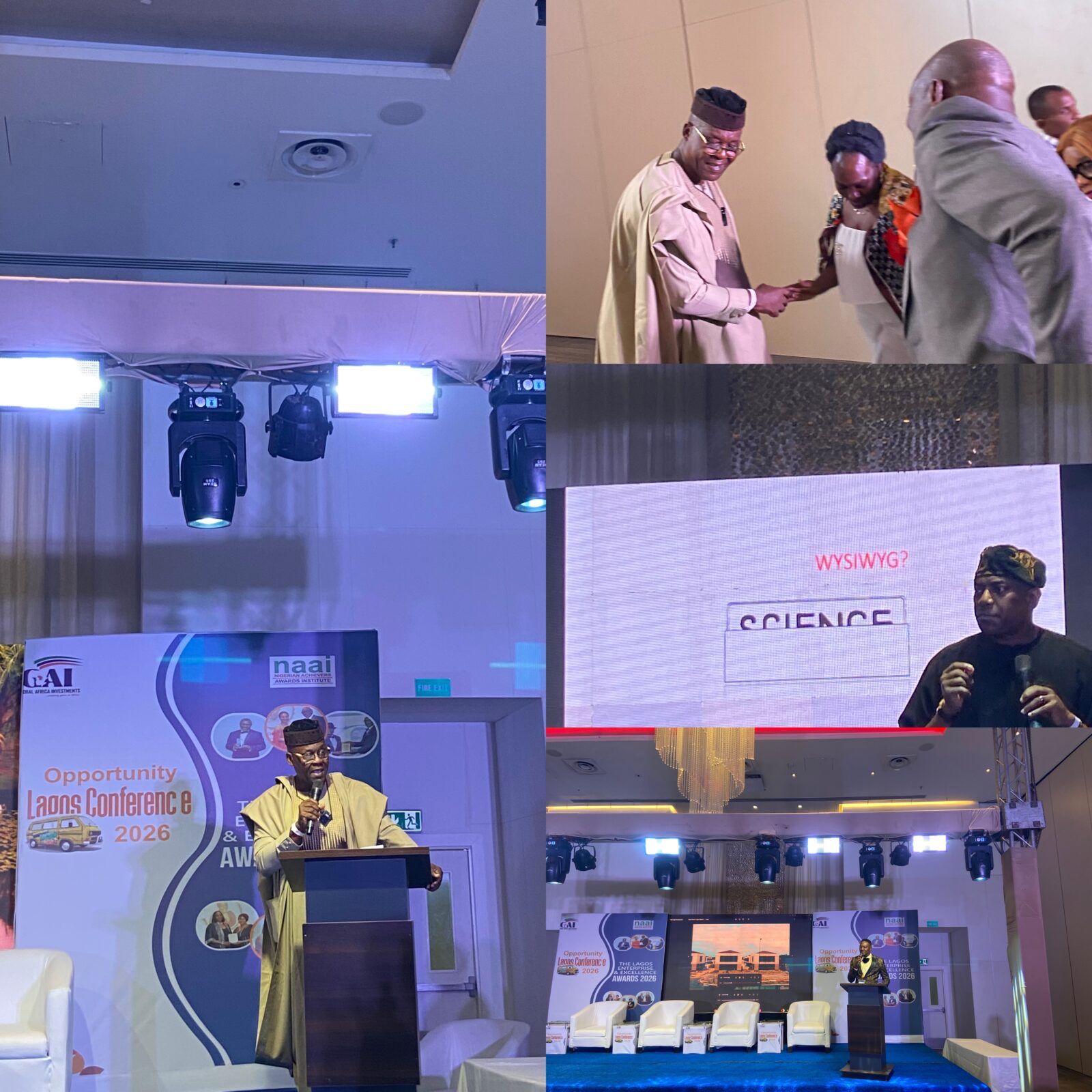

The Opportunity Lagos Conference 2026, held on Tuesday, June 30th, 2026, brought together renowned business leaders, investors and development experts who converged to discuss strategies for positioning Lagos and Africa as global hubs for innovation, tourism, investment and sustainable economic growth.
The conference, which attracted notable speakers including renowned tourism icon and Founder of La Campagne Tropicana Beach Resort, Otunba Wanle Akinboboye, leadership strategist Fela Durotoye, business executives and public sector leaders, commenced at exactly 11:44 a.m with the rendition of the Nigerian National Anthem.
Declaring the conference open, the Chief Executive Officer of Global Africa Investment Limited and Convener of the Opportunity Lagos Conference, Prince Afolabi Andu, welcomed guests and spoke on the effects of reshaping the narrative of Lagos through constructive dialogue and collaborative leadership.
According to him, Lagosians must take ownership of the city’s story by identifying opportunities capable of transforming the state into a stronger economic destination for investment, innovation and development.
The keynote address was delivered on behalf of the Lagos State Governor, Babajide Sanwo-Olu, by Ayo Abiodun, Deputy Governor, Corporate Lagos, who presented an overview of Lagos State’s economic performance, stating its Gross Domestic Product (GDP), tax revenue growth, infrastructure development and ongoing efforts to strengthen connectivity across the state.
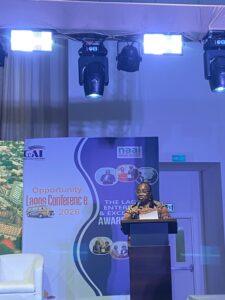
The first keynote session was delivered by renowned leadership strategist, Founder and Chief Executive Officer of Gemstone Group, Fela Durotoye, who spoke extensively on what he described as the “Story Age”, an era where narratives have become one of the greatest drivers of leadership and societal transformation.
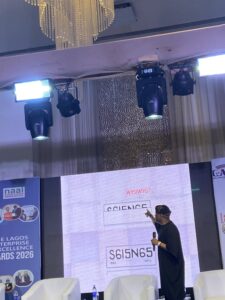
According to Durotoye:
“If stories are better told, people will follow the stories, not facts. The core element of leadership is shaping values, and stories stimulate and sustain prosperity.”
One of the major highlights of the conference was the presentation by Otunba Wanle Akinboboye, whose extensive address focused on Africa’s untapped economic potential, tourism, entrepreneurship and self-development.
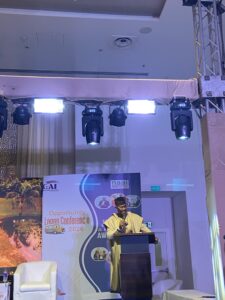
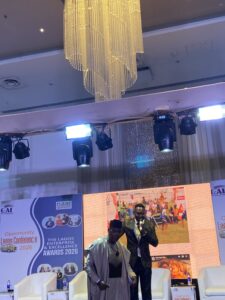
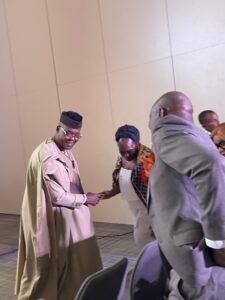
Taking the audience through an engaging analysis of global economies, GDP performance, economic principles, data, opportunities and Africa’s developmental history, Akinboboye also reflected on his decades-long journey of building La Campagne Tropicana Beach Resort into one of Africa’s foremost indigenous tourism destinations.
He added that Africa’s greatest asset lies in its people and challenged Africans to embrace self-discovery, innovation and indigenous development.
Guests at the conference were visibly captivated by his thought-provoking analysis of Africa’s immense opportunities and his passionate appeal for Africans both at home and in the diaspora to reconnect with their roots.
He further stated:
“Economics is the social science that studies how individuals , businesses governments and societies allocate limited resources to satisfy unlimited wants and needs.
It is, at its core, the science of choice because ‘wants’ and what each individual considers ‘needs’ are unlimited, but the means to satisfy them are not.
Every individual, nation and continent must decide how their needs and wants are satisfied.
Currently , the world is home to eight billion people.
While that is a large number, the earth’s resources should, if appropriately managed, be sufficient to provide for the reasonable needs of all of these people.
However, from all indications, the world’s available resources are unable to cater for everyone equally and while some areas of the globe flourish , others are impoverished.
The technology and development that form such a vital part of our lives has only fueled this situation .
The internet and social media have created and sustained a barrage of wants across the globe and significantly increased the world’s consumption figures.
It has created a situation where 8 billion people are consuming at levels that suggests multiples of the this population figure.
The world has become a global village. It has created platforms designed to drive a common and large perception of needs and wants .
Information travels instantly. Distance has collapsed and goods that once took months to arrive now reach your doorstep in a matter of days. There is pressure to consume at phenomenal levels.
But this has created a challenge for Africa as its production capacity is significantly below that of the so called ‘developed nations’ which are producing at lightning speed.
Their pace of production has turned us, by default, into consumer nations.
Today, over ninety percent of what Africa consumes is imported. We buy what others make. We pay for the finished product made from what our land grows. That imbalance keeps us impoverished.
When we speak of poverty we are are, in essence , referring to the inability to afford what another person has produced.
In making this statement, I am taking cognisance of the fact that all that a human being truly needs to survive costs nothing . The air we breathe, the water we drink and the food the earth gives us when we plant a seed cost us nothing.
It is our inability to purchase goods made by others that defines our poverty status and pulls us into the category of the impoverished .
The rapid industrialisation of the West has destabilised not just Nigeria, but the entire continent of Africa.
Despite the fact that our continent has an abundance of raw materials , its inability to produce finished products has made us dependent consumers in a world we should be leading as producers.
Africa covers 30.3 million square kilometres. It is the wealthiest continent on earth in terms of natural resources. Every known mineral, every climate, every ecosystem exists within the continent .
However , Africa remains the poorest continent in the world .
Its poverty is growing everyday , as our people stay on social media , imbibing the lifestyles promoted by influencers and consuming other people’s products when we should be transforming our own 30 million square kilometres of abundance into lasting wealth.
This is the paradox we must confront. And confronting our dilema should not be seen as an act borne out of anger. Instead it should be seen as a matter of economics – deliberate, disciplined and strategic economics.
Now let us talk about who we are and what we have. This is because before you can sell anything, you must understand your market.
Nigeria is made up of an estimated 242.4 million people , spread across 774 local governments. They provide a primary domestic audience of enormous scale.
There are close to 1.2 billion people living across the other 54 African countries.
We have approximately 30 million people of African descent in the Caribbean. We also have 49 million Black Americans based in the USA
sitting on a $2 trillion economy.
Finally we have 110 million people of African descent in Brazil and the broader Americas.
That is our target market. That is our diaspora. That is the audience no one else is speaking to the way we should be speaking to them.
And the question we must ask
ourselves is – why are we not taking full economic advantage of this relationship?
Consider the numbers. In 2025, Nigerians in the diaspora , who it is estimated conservatively comprise 17 million people , remitted approximately $21.8 billion to Nigeria. That is a meaningful sum and the highest level in five years.
However , it pales into insignifance if one compares it with India.
In the same period, the Indian diaspora of roughly 32.9 million people remitted $129 billion to India , which is a value that is six times more than Nigeria.
The difference is not in the size of the population. The difference is in the purpose of these transfers .
While the Indian diaspora sends money home to assist relatives, they also invest. They buy property, fund businesses, back startups, and build assets at home.
Investments from Non-Resident Indians (NRIs) account for a substantial 35% of the total Foreign Direct Investment (FDI) inflows into the country.
Between April and September 2024 the Indian diaspora inflows into specially designed Non Resident Deposit Schemes ( NRI) nearly doubled, reaching approximately US$10 million .
Successful examples of FDI driven by the Indian diaspora include Lakshmi Mittal’s leadership of ArcelorMittal, a multinational steel manufacturing corporation with significant operations and investments in India.
Additionally, Indian-origin venture capitalists have been instrumental in funding and mentoring prominent Indian startups like Flipkart, Ola, and Paytm, providing crucial capital and expertise to nurture India’s burgeoning entrepreneurial ecosystem.
The diaspora’s role extends to establishing multinational corporations and manufacturing activities in India, further bolstering the nation’s industrial and economic landscape.
The Nigerian diaspora largely, and I say this with gratitude for their generousity not criticism , sends residual money to parents, brothers, sisters, and dependants.
When that money arrives it pays school fees, fixes leaking roofs , provides for the month. And then it is gone.
We are sending money. We must begin sending investment.
As a young man of twenty-six years, and while living and working in the United States, I asked myself why Africa, with all its natural resources and brilliant people, was the poorest continent?
That question did not lead me to a symposium. It did not lead me to a petition or a protest. It led me to action and execution.
I made a deliberate decision to return. Not to just send money to my relatives , to return. To build. To invest my life, not just my savings, in this continent.
And out of that decision came the Continent Building Initiatives ( CBI )anchored in what I call the SET framework: Security, Entertainment, and Tourism.
I chose these three sectors deliberately because they provide employment without requiring entry-level qualifications. You do not need a PhD to work in security.
As an African, you are a natural born entertainer. Rythm, storytelling, and celebration are in your blood , they are a part of your inheritance.
And in tourism, you can participate at every level regardless of your educational background.
These are sectors that can employ the many, not just the few. These are sectors that can convert culture into currency. These are sectors that make the continent the product and the world the customer.
In 2005, we founded the Motherland Beckons movement, a platform created specifically to connect people of African descent, and lovers of Africa, to the continent .
Over the years, Motherland Beckons has facilitated over $200 million in diaspora-driven investments and welcomed thousands of visitors, including Marlon Jackson, African American mayors, and global cultural influencers. It remains a living bridge between Africa and its global diaspora.
Then, in 2024, we took that vision further. We founded the Ipada Initiative. Ipada —which word means ‘the return’ in Yoruba is exactly what it says. Ipada is proudly supported by President Bola Ahmed Tinubu, who serves as Grand Patron, Chief Host, and Global Ambassador.
The Ipada Initiative has a bold and specific vision: to facilitate the return of 100 million people of African descent and lovers of Africa to this continent by the year 2030.
Within its first year alone, Ipada mobilised over $1 billion in investments. Those investments include the development of cruise ships, the construction of resorts, a costume factory in Nigeria, geothermal energy exploration in Rwanda, DNA and tribal tracing programmes to reconnect the diaspora to their ancestral homelands, and a range of other landmark projects .
Ipada is not asking people to come back permanently. The proposal is simple, come back. Visit. Invest.
Spend part of what you have earned elsewhere in the world in the land that made you or from which you originated .
And watch what happens when hundreds of millions of people do that simultaneously.
Ghana is building for Ghana. South Africa is building for South Africa. Morocco, Kenya, Rwanda —each is building for itself. Those are fine, necessary, and noble efforts. But who is building for Africa as a whole? Who is standing up and saying: this entire continent, all 30 million square kilometres, all 55 nations, all 1.5 billion people — belongs to one family, and that family is scattered across the globe, and we are calling them home?
Nobody is claiming the continent. That space is open.
Ipada, built on the foundation of Nigeria, the cultural powerhouse of the continent whose music is now playing in every city on every continent , is claiming that space by creating a ‘shopping mall’ that showcases Africa as one destination.
Promoting Africa as one destination is deliberate .Look at what Europe has done by presenting itself as a single destination.
In 2025, Europe received 793 million international tourist arrivals, a 4% increase over 2024, and 6% above pre-pandemic levels. The European nations did not do that as individual countries competing with one another . They did it as a single region with a shared infrastructure, branding, and purpose. One visa. One region. Hundreds of millions of visitors.
Also look at Dubai. A city of fewer than four million people. A coastline built on desert. No natural diaspora. No ancient culture pulling people back. And yet in 2025, Dubai welcomed nearly 20 million international overnight visitors, its highest total ever. Hotel occupancy ran above 80% for the full year. December 2025 saw occupancy above 84%, with some rooms exceeding 1,000 dirhams per night.
Dubai made itself the crossroads of the world. There is no part of the globe you cannot reach from Dubai International Airport. They built connectivity, and connectivity built an empire.
Dubai, and all of Europe combined do not have one million people in an African-descended diaspora. Yet these are the destinations the world flows to.
We have 200 to 350 million people of African descent who already have an affinity to this continent. They dream about it, dance to its music, name their children after its rivers and landmarks .
We do not need to manufacture the desire. The desire already exists.
When I came back to Nigeria in 1984, I had been abroad long enough to understand what money can do.
If I had simply sent $10,000 home without returning, my relatives would have praised me . They would have told their neighbours. They would have said – Wanle has remembered us.
But a short time after that, the money would have been gone. Absorbed into daily living. Nothing would remain , no structure, no assets, no foundation. Just the memory of a moment of relief.
Instead, I came back to build, not just a resort. I came back to build my continent.
I reflect on this daily. I ask myself: what if I had not returned?
What would have happened to Nneka Blessing, the staff member who started as a cleaner at La Campagne Tropicana and has since saved enough to build her own house . She is not alone .
What would have happened to the town of Ikegun, which had just four concrete structures when the Resort was first established , with the rest of the village living under opa walls and thatched roofs and which now has over 4,000 cement houses?
What would have happened to the mat weavers of the community, whose craft was fading into obscurity, until we gave mats new life transforming them into a sought-after interior décor item and generating steady, dignified demand for an ancient skill?
What would have happened to the families- father, mother, and children who now all work at the Resort
What would have happened to the hundreds of bricklayers, carpenters, and artisans who learned their trade at La Campagne Tropicana and are now building African-themed resorts in Ghana, Ethiopia, and the Caribbean as genuine exporters of African craftsmanship?
What would have happened to the thousands of young men and women who passed through Corporate Guards Limited , the private security company I founded in 1989 to professionalise and dignify a sector that had ,at that time, been overlooked?
I also wonder about the village community in Ghana I recently donated 5 solar street lights to. The community deplọyed the lights amongst the clans in the village to provide communal light to their children for schoolwork and for the adults to have an alternative to crouching over kerosine lamps emitting noxious fumes.
In Nigeria, we often focus on mega projects forgetting how small investments can impact and change peoples lives.
It is estimated that there are 128,000 small villages in Nigeria. If 10% of Nigeria’s diaspora ( 1.7 million pẹople) donated US $20 each ( or less than the cost of 4 egg McMuffins at MacDonalds) to a fund to light up rural Nigeria , everyone of these villages could receive 5 solar street lights . This would impact positively on the lives of the recipient villages while creating opportunities for the villagers and improving life in Nigeria
In closing, I would like to emphasize that I strongly believe that it is not the wealth we leave for our children we should worry about, but the kind of society.
Thank you”
Other notable speakers included Ayo Akinmade, Executive Vice Chairman of Regus, who delivered an insightful presentation on unlocking Africa’s business potential, as well as Dr. Tunji Olagunju and several distinguished professionals who shared perspectives on investment, innovation, leadership, entrepreneurship and promoting Lagos as Africa’s preferred destination for business, tourism and economic opportunities.
The conference concluded with a renewed call for stronger public-private collaboration, indigenous innovation and strategic investments capable of positioning Lagos and Africa as globally competitive destinations for sustainable economic growth, tourism and enterprise.