


By Onyekachi Victoria Philip
Founder of La Campagne Tropicana Resort, Otunba Wanle Akinboboye has officially released another remarkable product, known as the African Eco Retreat (CAER) in November 2023 as part of his weekly 52-product initiative.

However, CAER is a larger idea to change where corporate organisations, government agencies and institutions hold retreats and what economic and social impact those retreats can create.
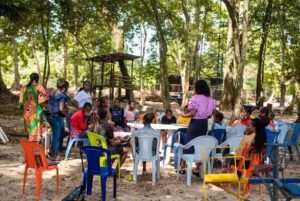
What exactly is Corporate African Eco Retreat?
Corporate African Eco Retreat is combines:
- Corporate retreats
- Team bonding
- Business meetings
- Leisure
- African culture
- Nature
- Eco-tourism
- Community interaction
- Corporate social responsibility
CAER proposes that they can hold the retreat in an African eco-tourism environment and Otunba Wanle Akinboboye developed a unique idea that, the retreat should not happen inside an isolated luxury hotel where corporate guests fly in, stay indoors and leave without interacting with the surrounding environment.

Instead, guests should be exposed to:
- African culture;
- nature;
- local communities;
- local traditions;
- eco-tourism activities;
- recreational experiences.
That is the main distinction of CAER.
The major problem CAER was created to solve
Otunba Wanle Akinboboye’s argument was based on a pattern common among Nigerian corporate organisations and government institutions.
When companies want to organise:
- management retreats
- strategic planning sessions
- staff bonding
- executive meetings
- leadership workshops
- annual reviews
- training programmes
The result is that organisations spend money on:
- international flights
- foreign hotels
- foreign restaurants
- foreign transport
- foreign entertainment
- foreign conference facilities.
He asked why organisations would spend heavily travelling abroad for retreats when African destinations could provide an equally meaningful experience.His criticism was particularly directed at the tendency of some government officials to prefer foreign retreats rather than developing local destinations.
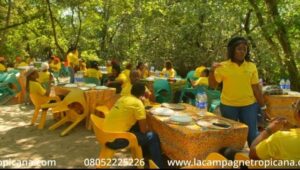
Why Corporate is important
The word Corporate means CAER was deliberately created for an important tourism market.Corporate tourism is a major part of the global travel industry.
Organisations regularly spend money on:
- conferences
- meetings
- incentive travel
- exhibitions
- staff retreats
- executive getaways
- training programmes.
Rather than depending only on tourists travelling for holidays, Akinboboye recognised that business organisations themselves can become a tourism market.
This is particularly connected to the concept known in tourism as:
Bleisure
Bleisure means combining:
Business + Leisure
A corporate executive may travel primarily for work but also participate in tourism and leisure activities.
An Independent analysis of Akinboboye’s 52 products specifically identified Corporate African Eco Retreat as one of the products targeting the growing business-and-leisure tourism market.
Why Africa Is Important
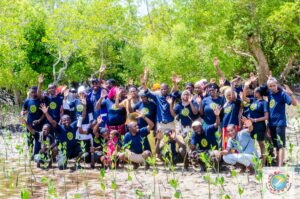
Akinboboye did not simply call it:
Corporate Eco Retreat but he added African and that word changes the entire philosophy.
The retreat is supposed to incorporate African identity into corporate experiences.
For example, instead of a completely Western-style corporate retreat involving only:
- PowerPoint presentations,
- hotel conference halls
- coffee breaks
- formal dinners
CAER imagines a retreat where corporate guests can also experience:
- African cuisine
- African music
- African architecture
- traditional storytelling
- indigenous recreation
- African fashion
- local crafts
- cultural performances.
The organisation can still conduct:
- strategic meetings
- planning sessions
- training
- leadership discussions.
But the environment surrounding the work becomes distinctly African.This is consistent with Akinboboye’s long-standing philosophy of Africanising tourism experiences rather than merely copying Western tourism models.
Why Eco is important
CAER is designed around eco-friendly tourism environments.This means the retreat ideally takes place in locations where people can interact with natural ecosystems such as:
- forests
- beaches
- rivers
- mountains
- lagoons
- wildlife environments
- rural landscapes.
Akinboboye’s environmental argument was particularly important.He argued that natural ecosystems are more likely to be preserved when they have economic value.
His philosophy can be summarised like this:
If nature generates sustainable income, people have a stronger reason to protect it.He specifically linked CAER to environmental preservation and climate concerns, arguing that making natural ecosystems economically valuable can create incentives for conservation. This is one of the deeper ideas behind the product.
- A forest that generates tourism income becomes more valuable standing than destroyed.
- A river that attracts tourists becomes an economic asset.
- A natural landscape becomes part of a sustainable business model.
He also pointed out that many eco-resorts are located in or close to rural communities and local government areas, where poverty may be more visible.
CAER attempts to create a connection between:
Corporate wealth
and
Local communities.
The theory is that when corporate organisations travel into these environments for retreats, opportunities emerge for local communities.
For example, corporate visitors may spend money on:
- accommodation
- food
- transportation
- local guides
- cultural performers
- artisans
- farmers
- local products.
Akinboboye gave examples of retreat supporting education for members of staff and other people as part of the social connection created during such gatherings. His point was that these relationships may never have occurred without bringing corporate people physically into those communities.
A normal corporate retreat might achieve:
- strategic planning;
- staff relaxation;
- team bonding.
CAER attempts to add:
- cultural immersion;
- environmental awareness;
- domestic tourism;
- community development;
- wealth redistribution;
- corporate social responsibility.
The economic argument behind CAER
Consider what happens when a large organisation takes 100 employees abroad for a five-day retreat.
The organisation could spend money on:
- airfare;
- accommodation;
- food;
- transport;
- meeting venues;
- entertainment.
Most of that money leaves Nigeria.
CAER asks:
What if a significant part of that spending remained within Nigeria or Africa?
The money could circulate through:
- resorts;
- hotels;
- local farmers;
- food suppliers;
- transport companies;
- entertainers;
- artisans;
- tourism operators;
- community businesses.
CAER and La Campagne Tropicana’s history
Although CAER was officially named the fourth product in the 52-product programme in 2023, the philosophy behind it is older.
La Campagne Tropicana has long operated as a location for:
- corporate retreats;
- company outings;
- conferences;
- team-building activities;
- leisure programmes.
Therefore, CAER can be seen as an attempt to formalise and package an existing tourism practice into a distinct product.
This is an important pattern across Akinboboye’s 52 products.
Some of the products were completely new concepts, while others represented:
Existing experiences -repackaged – named – standardised – for wider commercial use.
The concept builds on the existing experience of bringing corporate groups into African-themed eco-tourism environments and turning that experience into a replicable tourism product.
The difference between a conference and CAER
A conference is usually where people gather, listen, discuss and leave but CAER intends to be where people gather, conduct corporate activities, experience nature, participate in African culture, bond through recreation, connect with communities, create economic activity and potentially contribute to environmental preservation.