


By Damilola Adeyera

When a master is at work, do not disturb. That is one of the first lessons you learn when working with, and learning under, the tutelage of Otunba Olawanle Akinboboye, a man whose creative vision continues to find expression in endless possible ways.
In the space of a few weeks, Otunba Akinboboye has worn several hats. From participating as a panellist at the Ekiti Future Summit, where he pitched his agro-eco-tourism ideas, to overseeing renovation work at La Campagne Tropicana Forest Hills Cave Resort, Itanla, to directing Odigbose, his latest stage production, Otunba Olawanle Akinboboye is a relentless dream chaser.
What is Odigbose? It is a Yoruba word that translates to “goodbye forever”. Otunba Olawanle Akinboboye describes it as the first original African account of the slave trade era.
On Saturday, the stage play made its debut at the Muson Centre. The play unveiling was put together by Motherland Beckons—IPADA Initiatives in conjunction with the Nigerian Association of Chambers of Commerce, Industry, Mines, and Agriculture (NACCIMA).
The Beginning
At about 8 a.m. on Saturday, the day of the premiere, Otunba Akinboboye completed a quick inspection of La Campagne Tropicana Forest, River & Beach resort, Ibeju-Lekki, before heading to the Agip Hall of the MUSON Centre, Lagos, where he would coordinate, conduct, and direct final preparations for the premiere of his latest masterpiece.
For a man with so many responsibilities, the transition from resort manager to theatrical production appeared seamless. Spending and sharing this day with him allows one to see up close the work behind a stage play production.

Stage play production of this nature requires more than an imaginative mind. It demands attention to detail, coordination, patience, and an unwavering commitment to the final experience.
I was outside with my colleague enjoying a delightful lunch of jollof rice and beef, courtesy of Otunba Akinboboye, when I heard someone call out:
“Damilola, EA said you should come and assist them on the stage.”
I heard the instruction, and I followed.
Before long, I found myself on the stage, assisting with the arrangement of the wooden props. What initially appeared to be a simple assignment became an opportunity to observe the production from a vantage point few members of the audience would enjoy.
There I was, watching what I can only describe as the Steven Spielberg of our time, Otunba Olawanle Akinboboye, at work.
Who is Steven Spielberg? You may ask. Steven Allan Spielberg (/ˈspiːlbɜːrɡ/; born December 18, 1946) is an American filmmaker. A major figure of the New Hollywood era and pioneer of the modern blockbuster, Spielberg is widely regarded as one of the greatest and most influential filmmakers in the history of cinema and is the highest-grossing film director of all time, with his films having earned almost $11 billion worldwide, according to Wikipedia.
“I am not a filmmaker”, Otunba Olawanle Akinboboye would say to reminding everyone is calling is to direct and write stage plays. Although not a filmmaker, the directing capabilities of Otunba Olawanle Akinboboye on stage plays can be compared to that Steve Spielberg.
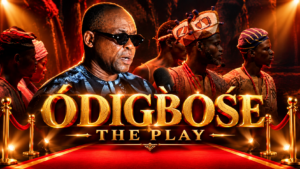
It was an entirely different experience from watching him speak at a public event or listening to him explain his vision for tourism, culture, and the creative arts. Here, at the Muson Centre his ideas had to assume physical form. The script had to translate into movement, the props had to occupy their proper positions, and every participant had to understand how their contribution fitted into the larger picture.
Every detail mattered. Every piece mattered. Every movement mattered.
Together, they formed the building blocks of a dramatic experience that transported the audience into the world of Ulontolo and Ulumila, the characters whose stories form part of the production’s narrative.

Beyond the spectacle of a stage production, the play raises an important question about who tells Africa’s stories and how those stories are preserved for future generations. The slave trade remains one of the most consequential chapters in African history, and the manner in which its experiences are interpreted, documented, and presented to younger generations matters.
Through theater, history can move beyond the pages of a textbook. It can become an experience, inviting audiences to engage with characters, confront difficult historical realities, and reflect on the consequences of the past.
For Otunba Akinboboye, whose creative ventures span tourism, entertainment, and cultural storytelling, Odigbose represents another attempt to bring an African narrative to life through an artistic medium.
Speaking exclusively with Atunda TV, Otunba Olawanle Akinboboye said, “The story of the African slave trade has been told by outsiders in many different ways, often misrepresenting the African side of it. A wrong impression has been presented that it was our kings who were willingly selling their subjects to the white men, but with this play, we try to correct that impression…. Most of those taken as slaves to Europe and the Americas were prisoners of war…. The white men supplied weapons to the African kingdoms and set them against one another to buy prisoners of war… they knew that no one would willingly hand over people, so they brought arms and weapons of war so that armies could go to war and they could have prisoners of war.