


By Damilola Adeyera
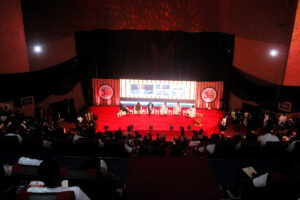
“Alaye, we don’t want a swimming pool in Ekiti State,” a member of the audience said while Otunba Olawanle Akinboboye, the founder and president of La Campagne Tropicana Forest River Beach Resort, delivered his speech on how Agro-Eco-tourism can lead to the massive development of the state.
Otunba Olawanle Akinboboye, who was invited by the Ekiti State Government for the Future Summit, a summit organized to celebrate thirty years of existence of the state, made a visionary and solid case on how the smart integration of agriculture and ecotourism can lead to prosperity for farmers, adventurous experiences for tourists, and development for the state.
The Head Huncho of La Campagne Tropicana wasn’t the only panelist at the summit who aired their passionate view about how the youths of Ekiti and Nigeria as a whole can embrace agriculture as a vehicle to attain wealth. Otunba Olawanle was joined by Temilade Ogunniyi, Dr. Muyiwa Igbalajobi, and Engr. Michael.

However, Otunba Olawanle Akinboboye’s view in particular stood out because, unlike the other speakers, his Agro-Eco-tourism concept sounded like an abstract to the audience.
As though responding to the skepticism expressed by the audience member, Otunba told a story about a time he went to visit a friend of his in Switzerland who was building a swimming pool on the top of a hill.
“When the pool was finished, it became an attraction for people. We take our hills for granted,” he said.
What then is Agro-Eco-tourism? Succinctly put, it is the integration of agriculture with ecotourism. However, to fully get an understanding of the concept. Let’s start from the first principle.
What does “agriculture” mean? Agriculture is the science, art, and practice of cultivating soil, growing crops, raising livestock, and preparing and marketing those products for human and industrial use.
How do we define ecotourism? The International Ecotourism Society defines ecotourism as responsible travel to natural areas that conserves the environment, supports local communities, and educates travelers.
Humans require food production, which alters landscapes (agriculture). Ecosystems require conservation and balance to remain viable long-term (ecology). People travel to experience landscapes, learn, and connect with living systems (tourism).
Thus, Otunba Olawanle Akinboboye’s school of thought defines Agro-ecotourism as the deliberate intersection where food-producing landscapes are managed so that visiting them funds conservation, educates the visitor, and keeps the land economically viable without exhausting it.
Speaking in an exclusive interview with Atunda TV, Otunba Olawanle said, “Agriculture can be boosted by ecotourism. Take our resort, for example: we currently have a chicken farm that will need another week or two before the birds start hatching. That is one of the fastest “crops” there is. But twenty different corporate bodies are coming for retreats before then. This means that in agro-ecotourism, you don’t have to wait for your crops to be ready for harvest before you benefit. You are already benefiting.
“Consider a cocoa farm. Cocoa takes about three years to mature, so by the time it is ready, the farmer is hungry and in debt, and his children are living in poverty before he makes a single sale. But if we develop an agro-ecotourism resort on a cocoa farm, Dangote will come. Students will come for picnics, and others will come for hiking, because agriculture and ecotourism operate within the same ecosystem of forest and nature.
“Once you make agriculture beautiful, you turn it into a beautiful bride, and young graduates will want to take part. They can buy the SUVs they want, which they cannot do from farming alone. With an agro-ecotourism resort like La Campagne, you can host major shows and bring in artists like Davido. They can buy an SUV and still be farmers. I am a farmer myself. We harvested almost ten thousand corn cobs yesterday, but we waited about a month and a half for them. If I had other facilities on the farm during that period, I would have been making money the whole time.
“The perception of farming is very poor. People see farmers as poor, and young men who farm will not easily find brides. If your daughter brought a farmer home to marry, would you be happy? You would probably say she would suffer for the rest of her life. But if she said, “My husband has an agro-ecotourism resort,” you would say, “Take her.” So we are making agriculture attractive for the young people who are running away from it.
“It is also easier to get funding this way. Agriculture attracts many loans and grants because it preserves nature. In Nigeria, ecotourism is not yet well understood, but there is a lot of money in agriculture. So agriculture can help ecotourism get funded. As you plant your corn, you are also building your lodge, your swimming pool, your volleyball court, and your table tennis area.
“In Ekiti, I told them to attach the agro-ecotourism concept to their advantage so that anyone anywhere in the world, not just in Nigeria, who wants an Ekiti tourism experience can have one, just as people go to the beach for a beach experience. Some people love going to the hills for hiking. If a hill is transformed from an attraction into a destination, with facilities built around it, it becomes extremely appealing, and you can draw out its economic value.
“Driving to Ekiti, I saw all the hills, but I only looked at them. I did not stop to eat breakfast or spend any money. That is an attraction with zero economic value. Until you raise that value, even by one percent, you have not begun. So you take the hill, the landscape, the perimeter, and the buffer zone. The buffer zone is the area around the hill that people can easily access. Using our resort as an example, the hill we are building toward is at the top. Our buffer zone includes Ekaabo, the cave restaurant, the farm area, and even the swimming pool area. These are the buffer zones people pass through before they begin climbing the hill.
“That is how you can easily get funding for an agro-ecotourism resort and how you can use agro-ecotourism to draw people to agriculture.”