
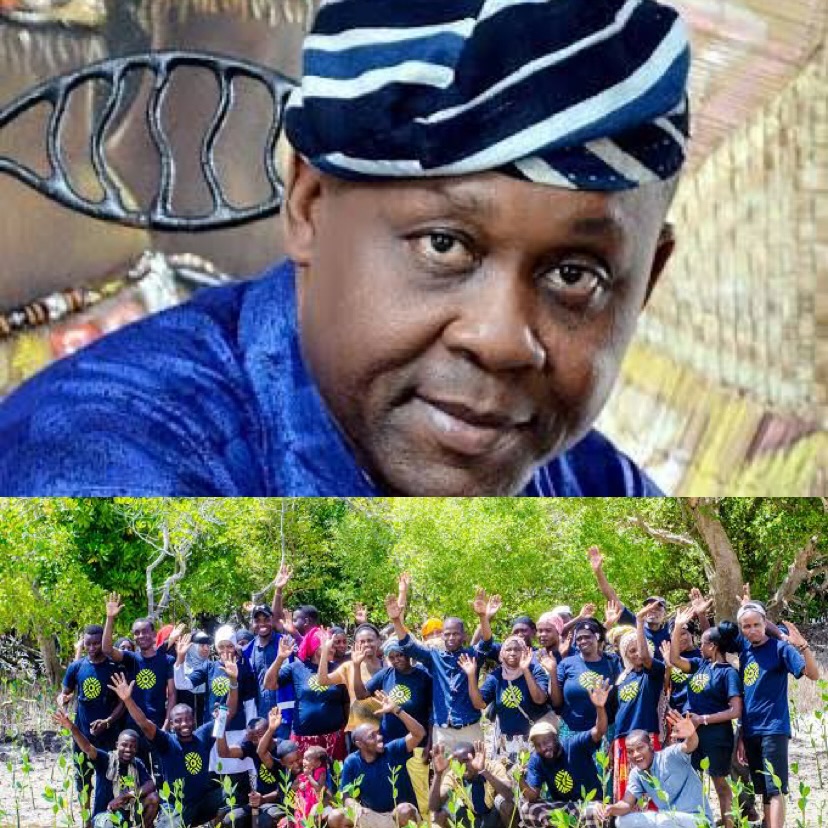

By Damilola Adeyera
Yesterday, Henri Kagan and Kenso Soai were jointly awarded the 2026 Nobel Prize in Chemistry for the discovery of non-linear effects and autocatalysis in asymmetric organic synthesis.
One thing should be made clear before readers go further in reading this article. As of the time of writing these words, there is no award in existence called the Nobel Laureate Peace Prize for Tourism. But if there ever will be one, let it be known that Otunba Olawanle Akinboboye is deserving of it.
Hence, this is an attempt to give you insight into the creative mind of Otunba Olawanle Akinboboye.
On the mountains. Inside the caves. On the land. And in the sea, Otunba Olawanle Akinboboye’s creative mind is solidly officiating the blissful marriage of man and nature.
READ MORE: La Campagne Tropicana is The Best Place to Fuel Your Imagination, Otunba Wanle Akinboboye
You see, dear reader, nature has always been man’s best friend. All that has always been needed is for a man to inspire people to appreciate, nurture, and live in harmony with nature. This is what Otunba Olawanle Akinboboye has done all his life.
Over the years, he has officiated the coming together of man and nature. His story started in 1989 when he founded Tropicana Spas and Pools. It became the first spa and pool company in Nigeria. This officially sealed and marked the beginning of his sojourn into the world of hospitality vis-à-vis tourism. His mind became a fertile ground for ideas on how to welcome, entertain, and give humans the very best of experiences.
However, the bigger story is not simply about spas and pools. It is about an idea. An idea that tourism can become a bridge between people, cultures, and nature. An idea that hospitality should not merely provide accommodation but should reconnect people with something they may have lost touch with: the natural world.
READ MORE: Detty December: Why You Need Corporate Security Guards This Festive Season

The basis of his vision is rooted in three pillars: security, entertainment, and tourism. Otunba Olawanle believes that before one can hope to achieve anything in Africa, there is a need to deal with the perception that Africa is a dangerous and unsafe continent, which means the primary priority has to be security. “I decided to change this perception by establishing a private security firm in 1989, Corporate Guards Limited,” he told Atunda TV.
He chose tourism as another of his pillars because he realized Africa’s unique flora, fauna, and culture could be packaged to present a unique tourism experience that could be used to grow the African continent.
“African culture and experience are best presented by Africans with their innate knowledge of African myths, lore, and concepts. However, one cannot rely merely on the existence of the experience; there is a need to package it in a manner that makes it attractive to the potential audience,” Otunba Olawanle believes.
READ MORE: 12 Rare Things Many Nigerians May Not Know About ATunda Entertainment
For him, making entertainment one of his life pillars was a no-brainer considering the influence that Africa and people of African descent have had on music and dance. “There are 3 major things Africans are passionate about—sports, religion, and entertainment. At a continental level, entertainment is the most binding; an Igbo man will
dance to the rhythms of Makossa even though he is unable to understand the lyrics of the song. I decided to focus on the revival of African music, dance, and fashion, which I realized had become unpopular with the inhabitants of my
continent, and to present in a cosmopolitan manner that made it acceptable to all. It is with this in mind that I founded Atunda Entertainment (atunda.tv) in 2005,” he said.
Security, Entertainment, and Tourism as a Language of Peace
It is based on these three pillars: security, entertainment, and tourism. The argument for a hypothetical Nobel Peace Prize for tourism becomes even more interesting. Peace is often discussed in the language of treaties, diplomacy, and politics. Do you know there is another form of peace that happens quietly?
Peace happens when a Nigerian travels to another part of Africa and discovers something beautiful. It happens when people from different cultures sit at the same table. It happens when tourists cross borders, eat unfamiliar food, listen to unfamiliar music, learn another people’s history, and return home with a broader understanding of humanity.
READ MORE: The Afro-Tourism Philosophy of Otunba Wanle Akinboboye
Tourism can make strangers familiar. It can make foreign cultures less foreign. It can create economic opportunities for communities while encouraging people to preserve the very landscapes that attract visitors. Again, this is where Akinboboye’s vision becomes larger than hospitality.
His East-West Africa Amalgamation vision seeks to encourage Africans to see the continent not as isolated territories competing against one another, but as interconnected societies capable of completing one another. His philosophy is simple but profound: Africa should complete, not compete.
READ MORE: PhotoStory: East West Amalgamation Brings Two African Giants Together
That philosophy has implications far beyond tourism. If people travel, trade, interact, and experience one another’s cultures, the psychological distance between them begins to shrink. The stranger becomes a neighbour. The foreign country becomes another part of home. And the continent becomes less divided in the minds of its people.
This is why Akinboboye’s journey through tourism is worth documenting. From his early hospitality ventures in Lagos to the development of La Campagne Tropicana Forest, River & Beach Resort, Ibeju-Lekki, Lagos State, La Campagne Tropicana Forest, Hills and Cave Resort, Ondo State, La Campagne Tropicana Agro-Eco Tourism Resort, Taraba, and now La Campagne Tropicana Hotspring, Ethiopia, there appears to be a consistent thread.
READ MORE: Discovering the Hidden Wonders of La Campagne Tropicana Forest, Hills and Caves Resort, Ondo State
Otunba Olawanle Akinboboye keeps asking the same question in different forms: How can human beings experience nature without destroying it? The answer has produced resorts, cultural experiences, festivals, entertainment platforms, and tourism destinations.
It has also produced an unusual architectural philosophy: rather than forcing nature to conform completely to the demands of development, development can be designed to work with nature. The forest can remain a forest. The river can remain a river. The mountain can remain a mountain. And yet, humans can enter these spaces, experience them, learn from them, and find joy within them.
A Peace Prize Beyond the Conventional
If the Nobel Peace Prize recognises individuals who make significant contributions toward peace, one can imagine a future where tourism itself receives recognition as an instrument of peace. If such a prize ever comes into existence, perhaps the first name worth considering would be that of Otunba Olawanle Akinboboye.
Not because he has merely built tourism facilities.
But because he has spent decades attempting to turn tourism into an encounter: between man and nature, between Africans and Africans, between culture and commerce, and between leisure and environmental consciousness.
Perhaps, dear reader, that is what peace sometimes looks like.