

By Onyekachi Victoria Philip
For many Nigerians, Hausa culture begins and ends with colourful kaftans, northern cuisine, the famous Durbar festival and the sight of horsemen parading through ancient cities. But beyond those familiar images lies a much deeper cultural world which is preserved in language, architecture, oral traditions, ancient trade routes, craftsmanship, religious history and social customs that can take considerable research to uncover.

Here are 15 aspects of Hausa culture that reveal a different side of Northern Nigeria.
1. Hausa Was Once Written Extensively in Ajami
Long before Latin-based writing became dominant, Hausa was also written using Ajami, an adapted Arabic script. Historical Hausa manuscripts and writings demonstrate that the language had a written tradition connected to Islamic scholarship and education.
The existence of Ajami challenges the simplistic assumption that Hausa’s written history began with the introduction of Western education.
2. Hausa Proverbs Can Function Like a Social Code
Hausa communication is deeply enriched by proverbs, idioms and indirect expressions. A seemingly simple statement can carry a deeper warning, lesson, criticism or piece of advice.
Rather than confronting someone directly in every situation, traditional expressions can allow a speaker to communicate a difficult message while maintaining respect and social harmony.

3. Kano Was Once Enclosed by an Extraordinary Defensive Wall
The city of Kano was once surrounded by an enormous earthen defensive system. UNESCO documentation describes the ancient wall system as extending around the historic city, with gates controlling access.
The structure provides evidence of the organisation, security concerns and urban development of one of the most important historic Hausa cities.
4. Dala Hill Carries More Than Scenic Value
Dala Hill is not merely a geographical feature overlooking Kano. It is associated with the early history of the city and the development of settlement in the area.
5. Traditional Hausa Architecture Was Built Around Privacy
The traditional Hausa compound was designed with more than appearance in mind.
Courtyards, entrances, walls and rooms could reflect family relationships, privacy, social status and the organisation of domestic life.
The architecture therefore provides a physical record of how people understood family and community.
6. Hausa Architecture Has Its Own Artistic Language
Traditional Hausa buildings can feature intricate moulding, decorative elements and distinctive architectural patterns.
These details demonstrate that Hausa architecture was not simply about constructing shelter. Buildings could also express identity, craftsmanship, wealth and social standing.
7. Kurmi Market Was Once Part of a Vast International Trading Network
Kano’s Kurmi Market was connected to commercial routes that extended beyond the immediate region.
Through trans-Saharan trade, goods moved between West Africa and North Africa, contributing to the development of Kano as a major commercial centre.
This history places Hausa cities within a much larger African trading network rather than portraying them as isolated settlements.
8. Hausa Craftsmanship Is Tied to Centuries of Commerce
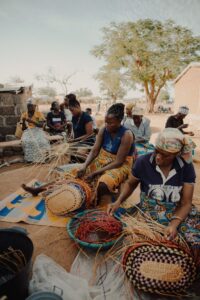
Leatherwork, textile production, weaving, dyeing and metalworking are more than cultural souvenirs.
These crafts are connected to the economic history of Hausa societies, where skilled artisans supplied local communities while merchants carried products across long-distance trade routes.
The survival of these crafts today represents a continuation of an economic and cultural heritage.
9. Hausa Culture Is Not Simply “Arab Culture”
The strong influence of Islam on Hausa society sometimes leads outsiders to incorrectly describe Hausa traditions as essentially Arab.
Hausa culture developed in West Africa and possesses its own language, history, architecture, social institutions, food traditions, artistic expressions and cultural identity.
Islam became profoundly influential, but Hausa identity and Arab identity are not synonymous.
10. Hausa and Fulani Are Historically Distinct Peoples
The expression “Hausa-Fulani” is widely used in Nigerian public discourse, but Hausa and Fulani have distinct historical and linguistic identities.
Over centuries, however, the two communities became deeply connected through Islam, intermarriage, scholarship, politics and the development of states such as the Sokoto Caliphate.
Understanding this distinction is important when discussing Northern Nigeria’s history accurately.
11. Bori Offers a Window Into Older Hausa Religious Traditions
One of the more complex areas of Hausa cultural history is Bori, a spirit-related religious tradition and performance culture.
Historical studies of Hausa society have examined Bori as evidence of religious practices that existed before or alongside the expansion of Islam.
Its survival and transformation demonstrate that cultures can contain several historical layers rather than changing completely from one period to another.

12. Hausa Folklore Was More Than Entertainment
Hausa storytelling traditionally served an important educational and social purpose.
Folktales could communicate lessons about morality, family, leadership, intelligence, foolishness, bravery and acceptable behaviour.
In societies where knowledge was transmitted orally, stories became a powerful means of preserving values from one generation to another.
13. Hausa Greetings Carry Social Meaning
A Hausa greeting is not necessarily just a casual “hello.”
Age, respect, social position, familiarity and circumstance can influence how people greet and address one another.
For visitors, understanding these subtle rules can provide an important insight into the Hausa emphasis on courtesy, respect for elders and social relationships.

14. The Ancient Hausa City Was a Complex Social Ecosystem
Hausa centres such as Kano, Katsina, Zaria and Daura were far more than collections of houses.
They developed interconnected systems of markets, artisans, farms, religious institutions, scholars, rulers, defensive structures and trade routes.
These cities reveal a sophisticated urban culture that cannot adequately be represented by the modern stereotype of Northern Nigeria as simply a landscape of villages and savannah.
15. Some of the Most Important Hausa Traditions Are Hidden in Everyday Life
Perhaps the most fascinating aspect of Hausa culture is that some of its richest traditions are not found at major festivals but in ordinary life.
They can be found in the arrangement of a compound, the meaning behind a proverb, the manner in which elders are greeted, the preparation and serving of food, traditional craftsmanship, storytelling and the way communities preserve knowledge.
For travellers willing to look beyond the obvious attractions, these everyday practices can offer a deeper understanding of Hausa civilization than a brief visit to a palace or festival ever could.
The story of Hausa culture is ultimately larger than the familiar images of horses, flowing garments and colourful festivals but a story of ancient cities, intellectual traditions, craftsmanship, commerce, architecture, oral history and social systems that have evolved over centuries.